Fragment and parent
TB-500: fragment identity
The rat stroke results get less straightforward as the amount rises. First, though, the molecule in that experiment needs its full name.
The rat stroke experiment
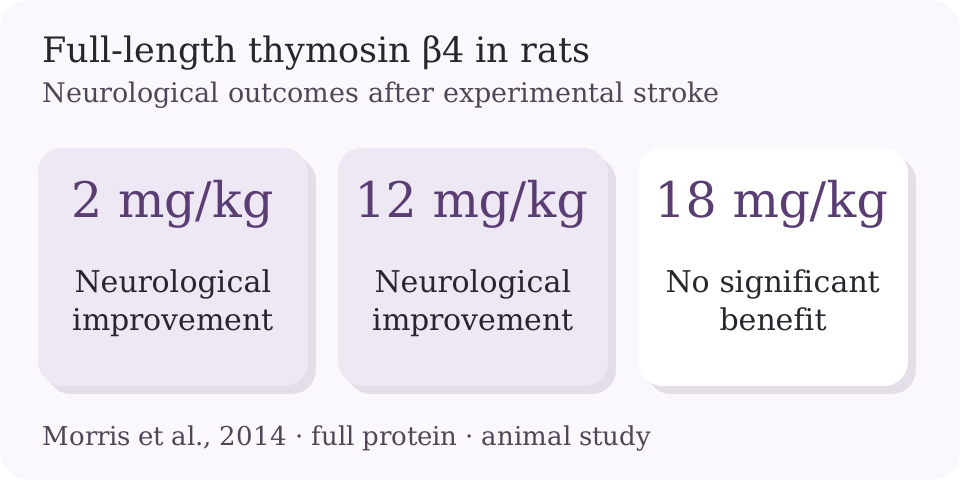
In male Wistar rats with an embolic stroke model, full-length thymosin beta-4 improved neurological function at 2 and 12 mg/kg. At 18 mg/kg, the study found no significant benefit. The animals received the protein intraperitoneally. These are study doses in rats.
I expected the upper dose to continue the pattern. It did not; I appreciate the authors testing beyond the apparent pattern. A response that bends back complicates the confident idea of simply increasing a repair signal. It leaves the useful question of why those experimental conditions produced that pattern.
Nothing in this result establishes an amount for a person, or an effect of the shorter TB-500 fragment. The study investigated the full parent protein.
Fragment identity
TB-500 denotes Ac-LKKTETQ, a synthetic seven-amino-acid fragment corresponding to residues 17–23 of thymosin beta-4. The full protein contains 43 amino acids. The fragment carries an actin-binding motif, a short sequence involved in the protein's interaction with the cell skeleton.
The sports-medicine review of peptide therapies provides the clinical context for the identity problem. Most efficacy work concerns full-length thymosin beta-4. Evidence that the isolated fragment reproduces that whole set of effects in people is missing. I object to letting the abbreviation quietly replace the name of the tested molecule.
Actin regulation
Actin supplies cells with a changeable internal skeleton. Full-length thymosin beta-4 binds free actin units and holds them in reserve, regulating how readily they assemble into filaments. A structural study using a gelsolin–thymosin beta-4 hybrid bound to actin showed how the interaction caps the actin monomer.
The review of thymosin beta-4 biology connects actin binding with cell migration, wound resurfacing, angiogenesis and reduced scar-forming cells across experimental models. These activities depend on the cells and tissues doing the responding. The fragment's retained sequence is a reason to test it carefully; the complete protein's activities still require attribution to the complete protein.
Full-length thymosin beta-4 in volunteers
A randomized, placebo-controlled study in 40 healthy volunteers examined intravenous synthetic thymosin beta-4. It reported infrequent mild-to-moderate adverse events, no dose-limiting toxicities and no serious adverse events. The full-length protein was used throughout.
I welcome the controlled design and the human observations. They give the parent protein a clinical safety starting point. For the TB-500 heptapeptide itself, completed controlled human trials remain absent, and its safety and efficacy remain unestablished. The 2026 review describes scarce rigorous human safety data and the potential for serious harm among unapproved peptides.
Growth signals and sport
The parent protein's pro-migration and pro-angiogenic activity raises a theoretical concern about tumour progression; thymosin beta-4 is implicated in cancer-related processes in the wider literature discussed around its regenerative biology. The risk from TB-500 in people has not been measured adequately. A plausible repair mechanism can also create a safety question.
TB-500 is prohibited in sport by WADA. A compounded preparation requires a prescription and has no FDA approval. The comparison page places this evidence beside BPC-157, GHK-Cu and KPV. For this compound, I would start any further research discussion by spelling out which molecule is actually being proposed.